Stripe alternatives: 50 payment platforms worth a look in 2026

Stripe is one of the most visited payment brands on the web. Public data in our data puts it at a Majestic rank of 136, a Tranco rank of 222, a founding year of 2010, a United States headquarters and roughly 8,000 employees. Size and reach are exactly why teams ask what else exists: a company that builds around one processor inherits that processor's country coverage, review process and support model.
This page lists 50 alternatives collected from public sources in November 2026 and sorts them into types: direct competitors, budget-friendly services, enterprise-grade acquirers, open-source projects, self-hosted software, regional providers, built-in options and adjacent tools. Each type has its own short guide further down, so you can jump to the group that matches your situation instead of reading a flat ranking.
A word on what this page is not. It is general information drawn from public sources, not financial, tax or legal advice, and payment rules depend on the country where you operate. We do not publish fees, approval odds or feature tables, because those change and are not in our data. Use the lists to build a shortlist, then confirm terms directly with each provider. For the full method see our methodology page, and for the wider field browse the payments and finance category.
Stripe is available at stripe.com. Public records list Stripe as founded in 2010. Its headquarters country is recorded as United States. The most recent public figure for its headcount is about 8,000 employees. Its domain ranks #136 in the Majestic Million, a free public list of the most-linked-to domains on the web. Its domain ranks #222 in the Tranco list of the most visited domains.
This page lists 50 alternatives to Stripe, spread across 8 types: direct (13), budget (3), enterprise (5), open source (7), self-hosted (1), regional (19), built-in (1), adjacent (1).
50 of the 50 entries were seen in live web search results during our November 2026 review; the remaining entries are labelled unconfirmed so you know where extra checking is needed.
Regional options cover India, Europe, Southeast Asia, Indonesia, Singapore, Japan, Russia, UAE and more.
- Direct: 13 (26%)
- Budget: 3 (6%)
- Enterprise: 5 (10%)
- Open source: 7 (14%)
- Self-hosted: 1 (2%)
- Regional: 19 (38%)
- Built-in: 1 (2%)
- Adjacent: 1 (2%)
50 of 50 entries (100%) were seen in live search results during our review; the rest are labelled “unconfirmed” and should be checked on the vendor site.
Quick comparison: the closest alternatives to Stripe
| Site | Name | Type | Founded | Majestic rank | Check |
|---|---|---|---|---|---|
| PayPal | Direct | 1998 | #84 | seen in search | |
 | Square | Direct | 2009 | #1,029 | seen in search |
 | Braintree | Direct | 2007 | #13,429 | seen in search |
 | Airwallex | Direct | 2015 | #20,319 | seen in search |
 | Rapyd | Direct | 2015 | #67,873 | seen in search |
What is Stripe and why do people look for alternatives?
Stripe is a payment services company founded in 2010 and headquartered in the United States. According to the public data we hold, its domain stripe.com ranks 136 in the Majestic Million and 222 on the Tranco list, which places it among the most referenced sites in its field. About 8,000 employees are listed. That is the extent of what our data states about the company; we do not describe its prices or product line here.
Online businesses generally use a provider like Stripe to accept card and wallet payments on a website or app. Developers integrate through an API, finance teams reconcile payouts, and support teams handle disputes. Because every one of those steps is tied to a single vendor, switching can feel expensive, which is also why many teams look for options before they are forced to.
The reasons people search for alternatives are fairly consistent across payment products. Some operate in a country where a regional provider supports local payment methods that a global processor handles less natively, such as Razorpay in India or Paystack and Flutterwave in Africa. Others are merchants of record sellers who want a provider like Paddle or Lemon Squeezy to take on tax collection. Some want a second processor for redundancy, and some want the flexibility of open-source orchestration such as Hyperswitch.
Others simply want a different commercial relationship: a smaller provider with a human account manager, a bank-grade acquirer such as Adyen or Worldpay for high volume, or the payments feature already built into a store platform such as Shopify Payments. None of these reasons means Stripe is a bad choice. They mean the right answer depends on country, product type and risk profile, which is what the rest of this page helps you sort out.
How we built this list
The list was compiled in November 2026 from public sources: ranking datasets such as the Majestic Million and Tranco, open knowledge bases such as Wikidata, and a review of public web search results for phrases people use when looking for a replacement. We recorded each product's domain, founding year and headquarters country where those facts were available, and left blanks where they were not.
Entries carry a status in the underlying data. Where a product was seen in search results as an alternative to Stripe, we mark it as seen in search. Where we could not confirm that in our review, it is described as unconfirmed, and we never present those as a top pick. All 50 Stripe entries were seen in search results during our review.
Types exist because a flat list of 50 payment companies is hard to use. A Nigerian online retailer and a software seller in Berlin do not need the same thing, so we group alternatives into direct, budget-friendly, enterprise-grade, open-source, self-hosted, regional, built-in and adjacent. Read the type hubs for the definitions, and the about page for how corrections are handled.
How to choose a Stripe alternative
Start with the country where your business is registered and the countries where your customers pay. Payment products differ most in geography: which currencies they settle, which local methods they support and which merchant categories they accept. A provider that is excellent in one region can be thin in another, so the first filter is not brand size but fit with your actual customer map.
Next, decide who carries compliance and tax. If you sell digital products globally, a merchant-of-record model, where the provider is the legal seller, shifts sales-tax and VAT handling away from you. Paddle, FastSpring and Lemon Squeezy appear in our direct group for this reason. If you sell physical goods through your own entity, a standard processor or acquirer is usually closer to what you need.
Then weigh control against convenience. An open-source orchestration layer like Hyperswitch gives you routing across processors but also gives you something to operate. A hosted service is faster to start but ties you to one vendor's roadmap. Finally, check the boring parts: payout timing, dispute handling, data export, and what happens to saved cards if you leave. These are not in our data, so verify them with the vendor before committing.
Remember that this is general information rather than financial, tax or legal advice, and that regulations vary by country. Use the criteria below as a checklist when you contact providers.
- Countries and currencies: confirm that both your business location and your customers' markets are supported for payouts and acceptance.
- Selling model: decide between being the seller of record yourself or using a merchant-of-record provider that handles tax on your behalf.
- Local payment methods: check for the wallets, bank transfers and cash-style methods your customers actually use.
- Migration of stored payment data: ask whether tokens or saved cards can be moved, and how long that takes.
- Risk and underwriting: high-risk or unusual merchant categories can be declined by some providers, so ask before you build.
- Integration effort: compare SDKs, webhooks, sandbox quality and documentation against your developer team's time.
- Support and escalation: find out how you reach a person when a payout is held or a dispute spikes.
Quick picks by situation
If you want the closest like-for-like replacement for a global card-acceptance setup, start with the direct group: PayPal, Square, Braintree and Adyen are the names with the strongest public footprints in our data. PayPal and Shopify Payments both carry very high Majestic rankings in our data, at 84 and 86 respectively, which signals reach rather than suitability.
If you are a software or digital-goods seller who wants someone else to be the legal seller, look at Paddle, FastSpring or Lemon Squeezy. If you are a small shop that wants low overhead, Helcim is listed in our budget group, and Square sits in the direct group. If your store already runs on Shopify, the built-in Shopify Payments route removes a separate integration entirely.
If you sell in India, Razorpay is listed with a 2014 founding year. For Europe, Mollie appears with a Netherlands headquarters. For Africa, Paystack and Flutterwave are the regional entries. For Latin America, Mercado Pago, dLocal and EBANX are named. For Southeast Asia, 2C2P, Xendit and Midtrans appear. Japan is represented by KOMOJU, and the Gulf by Tap Payments, PayTabs and Ziina.
If you process very high volumes and want a large acquirer relationship, the enterprise group lists Adyen, Checkout.com, Worldpay, Global Payments and Nuvei. If you want to avoid vendor lock-in and have engineers to spare, consider Hyperswitch, Lago, Kill Bill or Formance from the open-source group. If you want to accept Bitcoin on your own server, BTCPay Server is the self-hosted entry. For cross-border freelancers and marketplaces, our Payoneer page covers a related space.
All 50 alternatives to Stripe by type
Direct alternatives to Stripe (13)
Products that solve the same core problem for the same kind of buyer. Switching usually means moving data and retraining people, not changing how you work. For Stripe, this list contains 13 entries in this group, including PayPal, Square, Braintree, Airwallex and Rapyd. See all direct alternatives across every product →
Choosing among direct alternatives to Stripe
The direct group has 13 entries and is the closest to a like-for-like swap. It includes PayPal (founded 1998), Square (2009), Braintree (2007, United States), Airwallex (2015, Singapore), Rapyd (2015, Israel), Payoneer (2005, United States), Paysafe (1996, United Kingdom), Paddle, Lemon Squeezy, Polar, Creem, FastSpring (2005, United States) and Dodo Payments.
Within this group, the useful split is between classic processors and merchant-of-record sellers. Braintree, Square and PayPal are long-established names, while Paddle, Lemon Squeezy, Polar, Creem and Dodo Payments are positioned around selling digital products. Airwallex and Rapyd lean toward cross-border and global money movement, based on their listed countries.
Our Payoneer entry has its own page: see Payoneer alternatives if cross-border payouts are your main concern. For definitions of the group, read the direct alternatives hub. None of the entries here carry an unconfirmed flag in our data, but always verify availability in your own country.
| Site | Name | Type | Founded | Majestic rank | Check |
|---|---|---|---|---|---|
| PayPal | Direct | 1998 | #84 | seen in search | |
| Square | Direct | 2009 | #1,029 | seen in search |
| Braintree | Direct | 2007 | #13,429 | seen in search |
| Airwallex | Direct | 2015 | #20,319 | seen in search |
| Rapyd | Direct | 2015 | #67,873 | seen in search |
 | Payoneer | Direct | 2005 | #7,919 | seen in search |
 | Paysafe | Direct | 1996 | #21,522 | seen in search |
 | Paddle | Direct | n/a | #4,710 | seen in search |
 | Lemon Squeezy | Direct | n/a | #11,010 | seen in search |
 | Polar | Direct | n/a | #35,045 | seen in search |
 | Creem | Direct | n/a | #79,352 | seen in search |
 | FastSpring | Direct | 2005 | #13,176 | seen in search |
 | Dodo Payments | Direct | n/a | #83,305 | seen in search |
Budget-friendly alternatives to Stripe (3)
Lower-cost tools that cover the essential jobs without the full feature surface. A good fit when you pay for seats or features you rarely open. For Stripe, this list contains 3 entries in this group, including Helcim, PaymentCloud and Leaders Merchant Services. See all budget alternatives across every product →
Choosing among budget-friendly alternatives to Stripe
Three entries make up the budget group: Helcim, PaymentCloud and Leaders Merchant Services. Our data gives a domain and a Majestic rank of 98,712 for Helcim, while PaymentCloud and Leaders Merchant Services have no domain or ranking in our data, so there is little public data to lean on beyond the names themselves.
Budget in this context usually means a smaller merchant-services provider rather than a global platform, and the practical question is what you give up in exchange. Typical trade-offs include narrower developer tooling, fewer supported countries and a different support structure. We do not state prices, because they are not in our data and change often.
When comparing, ask for a written quote that lists every recurring and per-transaction charge, plus any early-termination terms. A low headline rate can be offset by monthly minimums or gateway fees. Larger names in the direct group such as Square and PayPal may be worth a quote for comparison. See the budget-friendly hub for more context.

Enterprise-grade alternatives to Stripe (5)
Platforms built for large teams: governance, audit trails, integrations and support contracts. They tend to cost more and take longer to roll out. For Stripe, this list contains 5 entries in this group, including Adyen, Checkout.com, Worldpay, Global Payments and Nuvei. See all enterprise alternatives across every product →
Choosing among enterprise-grade alternatives to Stripe
Five enterprise-grade options are listed: Adyen (founded 2006, Netherlands), Checkout.com, Worldpay (founded 1989, United Kingdom), Global Payments and Nuvei (founded 2003, Canada). These are acquirers and platforms typically associated with large merchants that negotiate custom terms.
The decision here is less about sign-up speed and more about contract structure, acquiring relationships and reporting depth. Large merchants often care about local acquiring in several countries, unified reporting across channels, and a named account team. Public ranks vary: Adyen sits at a Majestic rank of 6,612, Worldpay at 11,700, Checkout.com at 21,186, Global Payments at 25,671 and Nuvei at 48,639.
Expect a sales-led process and a longer implementation than a self-serve provider. Ask about migration support, parallel running during cutover and how card data transfers. If your volume does not yet justify that process, the direct group is usually a better first stop. The enterprise hub explains the type in more detail.
| Site | Name | Type | Founded | Majestic rank | Check |
|---|---|---|---|---|---|
 | Adyen | Enterprise | 2006 | #6,612 | seen in search |
 | Checkout.com | Enterprise | n/a | #21,186 | seen in search |
 | Worldpay | Enterprise | 1989 | #11,700 | seen in search |
 | Global Payments | Enterprise | n/a | #25,671 | seen in search |
 | Nuvei | Enterprise | 2003 | #48,639 | seen in search |
Open-source alternatives to Stripe (7)
Projects whose source code is public. You can inspect, modify and often self-host them, at the price of doing more of the maintenance yourself. For Stripe, this list contains 7 entries in this group, including Hyperswitch, Lago, Kill Bill, Zoneless and OpenCheckout. See all open source alternatives across every product →
Choosing among open-source alternatives to Stripe
Seven open-source projects are in the list: Hyperswitch, Lago, Kill Bill (founded 2010), Zoneless, OpenCheckout, Formance and Paymenter. They do not all do the same job. Hyperswitch is a payments orchestration project, Lago and Kill Bill are associated with billing and subscriptions, and Formance with ledger infrastructure, while Paymenter is aimed at hosting-style billing, according to their public positioning.
Open source does not remove the need for a payment processor or acquirer. Most of these projects sit on top of one, which means you still sign a processing agreement somewhere. What you gain is control over routing, billing logic and data, and what you take on is hosting, upgrades, security patching and compliance responsibility.
Public visibility is modest: Lago ranks 170,392 in Majestic and Paymenter 144,204, while Hyperswitch, Formance and Kill Bill rank above 499,000. Zoneless and OpenCheckout have no domain in our data. Review project activity directly before betting on one. Our open-source hub covers the type, and the self-hosted alternatives overlap when you run the software yourself.
| Site | Name | Type | Founded | Majestic rank | Check |
|---|---|---|---|---|---|
 | Hyperswitch | Open source | n/a | #499,657 | seen in search |
 | Lago | Open source | n/a | #170,392 | seen in search |
 | Kill Bill | Open source | 2010 | #583,243 | seen in search |
| Zoneless | Open source | n/a | n/a | seen in search | |
| OpenCheckout | Open source | n/a | n/a | seen in search | |
 | Formance | Open source | n/a | #553,663 | seen in search |
 | Paymenter | Open source | n/a | #144,204 | seen in search |
Self-hosted alternatives to Stripe (1)
Software you run on your own server or computer. You keep control of the data and the uptime, and you take on updates, backups and security. For Stripe, this list contains 1 entry in this group, including BTCPay Server. See all self-hosted alternatives across every product →
Choosing among self-hosted alternatives to Stripe
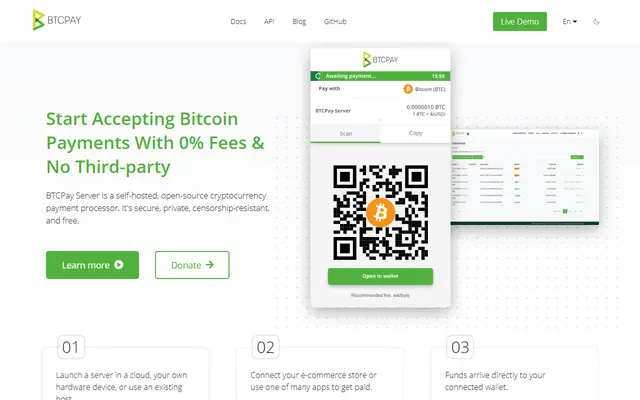
Only one self-hosted entry is listed: BTCPay Server, founded in 2017 and ranked 30,402 in Majestic. It is a server you run yourself for accepting Bitcoin, which makes it a very different proposition from a card processor. There is no company standing between you and your customers' payments, and no one else to call when something breaks.
That makes it a fit only for specific cases: merchants who want to accept cryptocurrency directly, privacy-minded sellers, or organizations that must hold their own keys. It is not a card-acceptance replacement. If your customers pay by card, you still need a conventional processor, and you may run BTCPay Server beside it rather than instead of it.
Before choosing it, plan for server hosting, backups, security updates and wallet management, and consider your local rules on accepting and reporting crypto income. These are general pointers, not tax or legal advice. For a broader view of running your own software see the self-hosted hub, and compare it with the open-source group, where Hyperswitch and Kill Bill fit.
| Site | Name | Type | Founded | Majestic rank | Check |
|---|---|---|---|---|---|
 | BTCPay Server | Self-hosted | 2017 | #30,402 | seen in search |
Regional and local alternatives to Stripe (19)
Vendors that are strongest in a particular country or region: local languages, local payment methods, local data-residency rules and local support hours. For Stripe, this list contains 19 entries in this group, including Razorpay, Mollie, Mercado Pago (LatAm), dLocal (LatAm) and EBANX (LatAm). See all regional alternatives across every product →
Choosing among regional alternatives to Stripe
Regional providers make up the largest group, with 19 entries. By area they include India (Razorpay, 2014), Europe (Mollie, Netherlands, 2004), Latin America (Mercado Pago, dLocal, EBANX), Southeast Asia (2C2P founded 2003, Xendit, Midtrans in Indonesia, HitPay in Singapore), Japan (KOMOJU), Russia (YooKassa, CloudPayments, Tinkoff Checkout, Robokassa), the Gulf (Tap Payments, PayTabs, Ziina in the UAE) and Africa (Paystack, Flutterwave).
The value of a regional provider is local depth: settlement in local currency, local methods and a local support team. The risk is narrow coverage, so if you sell across several regions you may combine a regional provider with a global one.
Check sanctions and legal availability before relying on any provider in a given country; this is general information and not legal advice. Majestic ranks give a rough sense of visibility, with Mollie at 3,772 and Razorpay at 6,600 as the most visible, and Tap Payments at 388,908 among the least. Our regional alternatives hub explains how the type is defined.
| Site | Name | Type | Founded | Majestic rank | Check |
|---|---|---|---|---|---|
 | Razorpay | Regional · India | 2014 | #6,600 | seen in search |
 | Mollie | Regional · Europe | 2004 | #3,772 | seen in search |
 | Mercado Pago (LatAm) | Regional | n/a | #72,955 | seen in search |
 | dLocal (LatAm) | Regional | n/a | #108,795 | seen in search |
 | EBANX (LatAm) | Regional | n/a | #43,074 | seen in search |
 | 2C2P | Regional · Southeast Asia | 2003 | #275,196 | seen in search |
 | Xendit | Regional · Southeast Asia | n/a | #97,236 | seen in search |
 | Midtrans | Regional · Indonesia | n/a | #225,262 | seen in search |
| HitPay | Regional · Singapore | n/a | n/a | seen in search | |
 | KOMOJU | Regional · Japan | n/a | #199,211 | seen in search |
 | YooKassa | Regional · Russia | n/a | #33,296 | seen in search |
 | CloudPayments | Regional · Russia | n/a | #75,744 | seen in search |
| Tinkoff Checkout | Regional · Russia | n/a | n/a | seen in search | |
 | Robokassa | Regional · Russia | n/a | #73,123 | seen in search |
| Tap Payments | Regional | n/a | #388,908 | seen in search | |
 | PayTabs | Regional | n/a | #207,544 | seen in search |
 | Ziina | Regional · UAE | n/a | #423,482 | seen in search |
 | Paystack | Regional · Africa | n/a | #25,131 | seen in search |
 | Flutterwave | Regional · Africa | n/a | #30,171 | seen in search |
Built-in features of platforms you already use to Stripe (1)
Capabilities that already ship inside a suite or platform you pay for. They rarely match a specialist tool feature for feature, but they cost nothing extra. For Stripe, this list contains 1 entry in this group, including Shopify Payments. See all built-in alternatives across every product →
Choosing among built-in alternatives to Stripe
The built-in group has one entry: Shopify Payments, founded in 2006 with a Canadian headquarters and a Majestic rank of 86. Built-in means the payment feature ships inside a platform you already use, so there is no separate vendor to integrate, and the platform handles much of the checkout experience.
The advantage is simplicity: fewer moving parts, one dashboard and one support path. The trade-off is dependence. If your store platform changes terms, or if you outgrow it, your payments setup is entangled with your storefront, which complicates a later move. Availability also depends on your country and on the platform's own rules.
Ask whether you can use a third-party processor alongside the built-in one, and what additional charges apply if you do. If you are not on that platform, this option is simply not available to you, and the direct group is the place to start. See the built-in hub for the type definition and related alternatives such as Xero in accounting.
| Site | Name | Type | Founded | Majestic rank | Check |
|---|---|---|---|---|---|
 | Shopify Payments | Built-in | 2006 | #86 | seen in search |
Adjacent tools to Stripe (1)
Products that cover part of the job or approach it from another angle. Useful when you only need a slice of the original product. For Stripe, this list contains 1 entry in this group, including Primer. See all adjacent alternatives across every product →
Choosing among adjacent alternatives to Stripe
Adjacent means a product that solves part of the same problem from a different angle. In this list there is a single adjacent entry: Primer, with the domain primer.io and a Majestic rank of 226,272. Based on its public listing, it is relevant to teams that want a layer above their processors rather than a replacement for them.
That distinction matters. An adjacent tool will not move money for you on its own; it changes how you manage the processors you already have or may add. It can make sense if you are planning to run more than one provider and want consistent integration, or if you are consolidating several checkout flows.
Because only one adjacent entry is listed, there is little to compare, so evaluate it against open-source orchestration such as Hyperswitch from the open-source group. Ask how long integration takes, what happens to your flow if the layer is unavailable, and who owns the relationship with each processor. The adjacent hub explains how we use the term.
Migration checklist: moving away from Stripe
A payments migration touches revenue directly, so plan it as a staged project, not a switch. Begin by listing everything that currently depends on Stripe: checkout pages, subscription logic, invoices, webhooks, refund flows, reporting exports and any accounting integrations. A short inventory prevents the most common surprise, which is a forgotten recurring payment that silently stops working.
Run the new provider in parallel with the old one for a period, routing a small share of traffic first. Keep the existing provider active for refunds and disputes on past transactions, because those usually need to be handled where the original payment was made. Do not cancel the old account until the last dispute window you care about has passed.
Stored customer payment data is the hardest part. Moving saved cards between providers typically requires a formal, secure transfer arranged between the two companies, and it is not something you can do by exporting a spreadsheet. Ask both sides early about timing and eligibility. Subscription customers are the most exposed, so test renewals before cutting over.
Update your accounting links as well; tools like QuickBooks or Xero may need new feeds so that payouts reconcile. This is general information, not tax or legal advice.
- Inventory every integration point: checkout, subscriptions, invoices, webhooks, refunds and reports.
- Export historical transaction and customer data before changing anything.
- Ask both providers about secure transfer of stored payment methods, and the expected timeline.
- Run the new provider in parallel on a small share of traffic before moving everyone.
- Keep the old account open for refunds and disputes until the relevant windows close.
- Update accounting feeds and payout reconciliation to match the new provider.
- Review customer-facing text such as receipts, statement descriptors and terms pages.
- Test failed payments, renewals and refunds in the sandbox before go-live.
Mistakes to avoid when switching
The most common mistake is choosing on brand visibility alone. A high Majestic rank, such as 84 for PayPal or 86 for Shopify Payments, tells you a site is widely linked, not that it fits your country, product or risk profile. Treat ranks as context and run your own checks.
Another frequent error is comparing only headline rates. Different providers structure charges differently, and a fair comparison needs a full list of fees for your actual mix of cards, currencies and refunds. Because we do not publish pricing, always request a written quote.
Teams also underestimate the work of replacing integrations. Even a well-documented API swap involves webhooks, retries, idempotency and reporting changes, and the smallest edge cases tend to surface in production. Finally, avoid a single cutover day. Staged rollout lets you catch problems while the old provider is still a fallback.
- Choosing a provider because it is popular rather than because it supports your countries and customers.
- Ignoring local payment methods that your customers actually prefer.
- Comparing headline rates without a full written schedule of charges.
- Cutting over everything in a single day with no fallback.
- Closing the old account before disputes and refunds on past sales are resolved.
What the public data says about these alternatives
Our data lists 50 alternatives to Stripe. By type, regional providers are the largest group with 19 entries, followed by direct (13), open-source (7), enterprise-grade (5) and budget-friendly (3). Self-hosted, built-in and adjacent have one entry each. That distribution suggests that geography is the main reason people leave a global processor, while a long tail of open-source projects serves those who want control.
Stripe itself has a Majestic rank of 136 and a founding year of 2010. Among alternatives, PayPal (84) and Shopify Payments (86) rank higher in Majestic, followed by Square (1,029) and Mollie (3,772), with most other names much further down. The oldest founding years in the data are Worldpay (1989), Paysafe (1996) and PayPal (1998). The most recent named years include BTCPay Server (2017) and Airwallex and Rapyd (2015).
Headquarters data is patchy. Where stated, it includes the United States, Singapore, Israel, the United Kingdom, the Netherlands, Canada and India. None of the entries in our data carry an unconfirmed flag, but many have missing fields, so absence of a founding year should not be read as a weakness. For how the figures are gathered, see the methodology.
Frequently asked questions
What is the best free alternative to Stripe?
There is no free payment processor in the usual sense, because accepting cards always involves some cost somewhere. The closest options in our data are open-source projects such as Hyperswitch or Kill Bill, which are free to download but still need a processor behind them plus your own hosting. Check each project's licence and the processor's terms before relying on either.
Is there an open-source alternative to Stripe?
Our list names seven open-source projects: Hyperswitch, Lago, Kill Bill, Zoneless, OpenCheckout, Formance and Paymenter. They cover orchestration, billing and ledger functions rather than acting as a bank or acquirer, so you will still need a processing relationship. Compare them in our open-source hub and review each project's maintenance before adopting.
Which Stripe alternative is cheapest?
We do not publish prices, because they change and are not part of our data. The budget group lists Helcim, PaymentCloud and Leaders Merchant Services as smaller services worth a quote. Request a written schedule of every recurring and per-transaction charge from each provider, and compare it against your actual transaction mix before deciding.
Can I use Stripe and another provider at the same time?
Many businesses run more than one provider for redundancy or to cover different countries. Orchestration tools such as Hyperswitch and Primer exist for that purpose, routing traffic across processors. The trade-off is extra integration work and reconciling payouts from two places, so make sure your accounting setup can handle both feeds.
Which alternative works best for software sellers who want tax handled?
Merchant-of-record providers act as the legal seller, which shifts tax collection to them. Paddle, FastSpring and Lemon Squeezy appear in our direct group for that reason. Terms, supported countries and fees differ, so confirm what they cover for your product and territory. This is general information, not tax or legal advice.
What are the best Stripe alternatives for specific regions?
Regional providers listed include Razorpay for India, Mollie for Europe, Paystack and Flutterwave for Africa, Mercado Pago, dLocal and EBANX for Latin America, Xendit and 2C2P for Southeast Asia, and KOMOJU for Japan. Availability and rules vary by country, so confirm that each supports your business type before applying.
How hard is it to switch away from Stripe?
It depends on your setup. A simple checkout can move in days, while subscriptions, saved cards and custom webhooks take longer. Moving stored payment methods usually needs coordination between providers. Run both in parallel, keep the old account for refunds and disputes, and test renewals before cutting over completely.
Can I export my customer and transaction data?
Most payment providers offer some form of data export, but formats and scope differ, and we do not verify them. Before choosing a replacement, ask the new provider what it can import and ask your current provider what it can export, including whether stored payment methods can be transferred securely between the two companies.
Do any of these alternatives accept Bitcoin?
BTCPay Server is the self-hosted entry in our list, and it is built for accepting Bitcoin on your own server. It does not replace card processing, so many merchants run it alongside a conventional processor. Check your country's rules on crypto payments, which this page does not cover as legal or tax advice.
Bottom line
There is no single best replacement for Stripe, because the right answer depends on where you sell, what you sell and how much operational work you want to own. For most small online sellers, the direct group is the place to start. For regional needs, a local provider usually fits better, and for engineering-heavy teams, open-source orchestration offers control at the cost of running more infrastructure.
Build a shortlist of three, ask each for a written fee schedule and a migration plan, and run a small parallel pilot before moving everything. Remember that this page is general information from public sources and not financial, tax or legal advice. Related reading: Payoneer alternatives, Ramp alternatives and the payments and finance hub.
More alternatives pages related to Stripe

Where Stripe shows up as an alternative
Stripe appears in the alternatives lists of 4 other products: FreshBooks, QuickBooks, MYOB, Ramp. Comparing those lists shows which tools keep being recommended across the whole category.
Explore more in Payments, Spend & Crypto
Payment processing, corporate cards, expense management and exchanges. Browse the full Payments, Spend & Crypto hub, or jump to a related comparison: Ramp, Coinbase.