ServiceNow alternatives
ServiceNow is a corporate ITSM and workflow platform, and plenty of teams that use it or evaluate it eventually ask the same question: is there something lighter, cheaper or simpler that still covers incidents, requests, changes and assets? This page collects 50 candidates from public sources and sorts them by type, so you can compare like with like instead of scrolling through one flat list.
The list runs from commercial ITSM suites such as Freshservice, Jira Service Management and SysAid, through open-source tickets and CMDB tools such as GLPI, iTop and Zammad, to regional vendors like TOPdesk, Naumen Service Desk and Movidesk. It also includes a few non-obvious routes: building a request system inside Microsoft 365, or using a low-code platform such as NocoBase.
Treat it as a research shortlist, not a ranking. We do not publish prices, feature matrices or hands-on scores here, and some entries are marked as not confirmed in our search review. Use the sections below to narrow the field, then check every candidate directly with the vendor before you commit.
ServiceNow is available at servicenow.com. Public records list ServiceNow as founded in 2004. Its headquarters country is recorded as United States. The most recent public figure for its headcount is about 10,371 employees. Its domain ranks #3,668 in the Majestic Million, a free public list of the most-linked-to domains on the web. Its domain ranks #6,261 in the Tranco list of the most visited domains.
This page lists 50 alternatives to ServiceNow, spread across 10 types: direct (15), budget (3), free (1), enterprise (3), open source (11), self-hosted (1), regional (8), built-in (1), adjacent (5), diy (2).
40 of the 50 entries were seen in live web search results during our November 2026 review; the remaining entries are labelled unconfirmed so you know where extra checking is needed.
Regional options cover Russia, Europe, Latin America.
- Direct: 15 (30%)
- Budget: 3 (6%)
- Free: 1 (2%)
- Enterprise: 3 (6%)
- Open source: 11 (22%)
- Self-hosted: 1 (2%)
- Regional: 8 (16%)
- Built-in: 1 (2%)
- Adjacent: 5 (10%)
- DIY: 2 (4%)
40 of 50 entries (80%) were seen in live search results during our review; the rest are labelled “unconfirmed” and should be checked on the vendor site.
Quick comparison: the closest alternatives to ServiceNow
| Site | Name | Type | Founded | Majestic rank | Check |
|---|---|---|---|---|---|
 | Freshservice | Direct | n/a | n/a | seen in search |
 | Jira Service Management | Direct | 2002 | #502 | seen in search |
 | Xurrent | Direct | 2010 | #173,248 | seen in search |
 | SolarWinds Service Desk | Direct | 1999 | #4,713 | seen in search |
| Atera | Direct | n/a | #49,649 | seen in search |
What is ServiceNow and why do people look for alternatives?
According to our data, ServiceNow is a corporate ITSM and workflow platform, headquartered in the United States and founded in 2004. Its domain, servicenow.com, sits at Majestic rank 3,668, which tells you it is a widely referenced brand. In practice, platforms of this kind sit at the centre of how a large IT organisation handles incidents, service requests, changes, assets and approvals, and they often extend into workflows for HR or facilities.
The public record also shows an active corporate story. The press releases we reviewed report that the Moveworks acquisition closed in December 2025, Veza in March 2026, and Armis, a deal of around 7.75 billion USD, in April 2026. Armis products continue to be sold separately. We mention this only as context: it shows a vendor that is expanding, which for some buyers is reassuring and for others is a reason to ask how the platform will look in a few years.
Why do people look elsewhere? Our sources do not quote reasons, so we stay general. Platforms built for large enterprises tend to bring long implementations, specialist administrators and licensing that is negotiated rather than published. Smaller IT teams may only need tickets, a knowledge base and an asset list. Others want to stay close to a development toolchain, keep data on their own servers, buy from a regional vendor in their language, or use an open-source product with no licence fee.
That is why the alternatives below are grouped by type rather than ranked. A twelve-person IT team and a global bank are not shopping for the same thing. The IT management category shows how this product relates to monitoring and endpoint tools, and the sections that follow help you pick a type before you pick a name.
How we built this list
The list was compiled in November 2026 from public sources: vendor sites, web search results, comparison pages, directories and open-source project pages. For every entry we recorded the type, domain, country where known, founding year and Majestic rank where those were available. We did not install or test any product, and we do not check prices, features or current availability. The full approach is described on the methodology page.
Each entry carries one of two labels internally. Seen in search means our review found the product in current search results. Unconfirmed means we could not confirm it in that review; it may still exist, but we describe such entries cautiously and never put them forward as a top pick.
Types exist because the word alternative hides very different trade-offs. A free open-source ticketing tool and a rival enterprise suite solve the same headline problem in opposite ways. Splitting into direct, budget-friendly, free, enterprise-grade, open-source, self-hosted, regional, built-in, adjacent and DIY lets you filter by what matters to you. You can read the definitions on the direct alternatives and open-source hub pages.
How to choose a ServiceNow alternative
Start by writing down what you actually use ServiceNow for. Many organisations adopt a platform for incident management and later add change, asset, knowledge and request catalogues. If only two of those matter to you, a narrower tool may be enough. If you lean on a configuration database and approval chains across several departments, you need a product with comparable process depth, and that narrows the field to the commercial suites at the top of the list.
Next, decide where the product has to live. Some teams must keep data on their own infrastructure, which points to the self-hosted and open-source groups. Others want a cloud service managed by the vendor and have no appetite for patching servers. Be honest about internal capacity: open-source software has no licence fee, but someone has to install, secure and upgrade it.
Then consider the surrounding toolchain. A service desk is rarely alone; it connects to monitoring, endpoint management, chat, identity and development tools. A vendor whose strength is development workflow, such as Jira Service Management, fits differently from one that bundles remote management, such as Atera. Finally, check the ITIL language the product uses, because your auditors and your staff may expect particular process names.
Our public data cannot answer pricing or feature questions, so use it to build a shortlist of three to five and then request demos or trials directly from vendors. Compare them on the same sample scenarios from your own queue.
- Process scope: incident, request, change, problem, asset and CMDB, and which of them you really need.
- Hosting model: vendor cloud, your own servers, or a regional provider in your jurisdiction.
- Administration effort: whether a generalist can configure workflows or you need a specialist.
- Integrations: monitoring, identity, endpoint tools, chat and your development tracker.
- Reporting and audit trail: what your auditors expect to see for changes and approvals.
- Language and local support: interface languages and vendor presence in your country.
- Exit route: how you export tickets, knowledge articles and asset records later.
Quick picks by situation
These are starting points drawn from the notes in our data, not endorsements. If you want something simpler and cheaper but still ITIL-minded, our data describes Freshservice as simpler and cheaper with ITIL support. If your IT team shares a roadmap with developers, Jira Service Management is noted for its link to development work through Atlassian.
For a budget-driven search, ManageEngine ServiceDesk Plus is described as inexpensive, ITIL-aware and available on-premises; see also the ManageEngine alternatives page. Zoho Desk is noted as inexpensive for customer support, and ProProfs Help Desk as simple and affordable. If you already run a managed-services model and want remote management bundled with ticketing, Atera is described as RMM plus ITSM.
If a licence fee is the obstacle, GLPI covers inventory, tickets and a CMDB, and iTop (Combodo) is described as open-source ITSM plus CMDB. Teams that only need basic tickets can look at osTicket, noted as simple ticketing. For a large enterprise comparison, BMC Helix is described as a direct enterprise competitor, and the Ivanti page covers another enterprise ITSM and endpoint option.
If you work in Europe and want a modular product from a regional vendor, TOPdesk is described as a modular ITSM, and we cover it on its own TOPdesk alternatives page. If you manage a service-company workflow in Russia, Okdesk is noted for service companies. For a purely customer-facing help desk rather than internal IT, the data flags Zendesk as customer support, not ITSM, so see the Zendesk alternatives page instead.
All 50 alternatives to ServiceNow by type
Direct alternatives to ServiceNow (15)
Products that solve the same core problem for the same kind of buyer. Switching usually means moving data and retraining people, not changing how you work. For ServiceNow, this list contains 15 entries in this group, including Freshservice, Jira Service Management, Xurrent, SolarWinds Service Desk and Atera. See all direct alternatives across every product →
Choosing among direct alternatives to ServiceNow
The direct group is the largest, with 15 entries, and it holds commercial platforms that compete for the same ITSM budget. Freshservice, Jira Service Management, Xurrent, SolarWinds Service Desk, SysAid, InvGate and Motadata are described in our data as ITSM or service-desk products at different sizes. Xurrent is noted as renamed, ITSM and ESM, while InvGate is listed as ITSM plus asset management and Atomicwork as AI-first ITSM.
A few entries are not pure ITSM. Atera pairs remote monitoring and management with ITSM, SmartSuite is no-code, monday service is the service module of monday, and Zendesk is flagged as customer support rather than ITSM. HappyFox is a help desk for small and mid-sized organisations. HaloITSM and Deskpro were not confirmed in our search review, so verify they are still sold before including them.
To choose, sort the group by who runs the platform. A team with a dedicated administrator can handle deeper configuration; a team without one should favour products whose notes stress simplicity. Compare how each handles change approvals and asset records, because that is where lighter tools usually stop. The direct alternatives hub explains this type in more detail.
| Site | Name | Type | Founded | Majestic rank | Check |
|---|---|---|---|---|---|
| Freshservice | Direct | n/a | n/a | seen in search |
| Jira Service Management | Direct | 2002 | #502 | seen in search |
| Xurrent | Direct | 2010 | #173,248 | seen in search |
| SolarWinds Service Desk | Direct | 1999 | #4,713 | seen in search |
| Atera | Direct | n/a | #49,649 | seen in search | |
 | SmartSuite | Direct | n/a | #124,245 | seen in search |
 | monday service | Direct | 2012 | #1,281 | seen in search |
 | Zendesk | Direct | 2007 | #204 | seen in search |
 | HappyFox | Direct | n/a | #39,104 | seen in search |
 | SysAid | Direct | n/a | #14,084 | seen in search |
 | InvGate | Direct | 2009 | #76,212 | seen in search |
 | Atomicwork | Direct | n/a | #331,748 | seen in search |
 | Motadata | Direct | n/a | #241,046 | seen in search |
 | HaloITSM | Direct | n/a | #423,964 | unconfirmed |
 | Deskpro | Direct | n/a | #143,363 | unconfirmed |
Budget-friendly alternatives to ServiceNow (3)
Lower-cost tools that cover the essential jobs without the full feature surface. A good fit when you pay for seats or features you rarely open. For ServiceNow, this list contains 3 entries in this group, including ManageEngine ServiceDesk Plus, Zoho Desk and ProProfs Help Desk. See all budget alternatives across every product →
Choosing among budget-friendly alternatives to ServiceNow
Three entries make up the budget-friendly group: ManageEngine ServiceDesk Plus, Zoho Desk and ProProfs Help Desk. Our data describes the first as inexpensive with ITIL coverage and an on-premises option, the second as inexpensive and aimed at customer support, and the third as simple and inexpensive.
The differences matter more than the shared label. ServiceDesk Plus is the one with ITIL language and a self-hosted option, so it suits an internal IT department. Zoho Desk is oriented toward supporting customers, so it is a better fit when the audience is outside the company. ProProfs Help Desk sits at the simple end and suits small teams that need tickets without process depth.
Low sticker cost is only one part of total cost, and we do not publish prices. Ask each vendor about user or agent licensing, add-on modules for assets or change management, and what happens at renewal. For the broader picture of inexpensive options, see the budget-friendly hub and the vendor pages for ManageEngine and Zoho.

Free options to ServiceNow (1)
Tools with a free plan or free access that is usable on its own. Limits on volume, users or history usually apply, so check them before you commit. For ServiceNow, this list contains 1 entry in this group, including Spiceworks. See all free alternatives across every product →
Choosing among free alternatives to ServiceNow
Only one entry is listed as free: Spiceworks, noted in our data as free with advertising. That is a trade-off rather than a gift. An ad-supported product keeps the licence cost at zero, but you accept the ads and the vendor's roadmap decisions, and you should check what happens to your data if the service changes.
Because the free group is so thin, many readers will really want the open-source group, where the software itself carries no licence fee. Examples include GLPI, Zammad, osTicket and Frappe Helpdesk, covered below. Those have a different cost: your own hosting and staff time.
If you are considering a free tool as a stepping stone, ask three questions. Can you export tickets and knowledge articles in a usable format? Is there a clear upgrade path if the team grows? And does the product support the processes your auditors expect? The free alternatives hub lists how this type is defined across categories.
| Site | Name | Type | Founded | Majestic rank | Check |
|---|---|---|---|---|---|
 | Spiceworks | Free | 2006 | #3,603 | seen in search |
Enterprise-grade alternatives to ServiceNow (3)
Platforms built for large teams: governance, audit trails, integrations and support contracts. They tend to cost more and take longer to roll out. For ServiceNow, this list contains 3 entries in this group, including BMC Helix, Ivanti Neurons for ITSM and Salesforce Service Cloud. See all enterprise alternatives across every product →
Choosing among enterprise-grade alternatives to ServiceNow
Three platforms sit in the enterprise-grade group: BMC Helix, Ivanti Neurons for ITSM and Salesforce Service Cloud. Our data calls BMC Helix a direct enterprise competitor, describes Ivanti Neurons for ITSM as enterprise ITSM plus endpoints, and notes that Salesforce Service Cloud is enterprise with an emphasis on customers.
BMC Helix, founded in 1980 and headquartered in the United States, and Ivanti, founded in 1985 and also US-based, are the natural comparison if your reason for leaving is not size but fit. Salesforce Service Cloud points the other way: it suits organisations whose service operation faces customers and who already live in the Salesforce ecosystem.
Enterprise-grade alternatives rarely reduce complexity; they trade one set of constraints for another. Run a proof of concept on a real workflow such as onboarding or major-incident handling, and ask about migration services for existing records. Read our dedicated pages on Ivanti and Salesforce and the enterprise-grade hub.
| Site | Name | Type | Founded | Majestic rank | Check |
|---|---|---|---|---|---|
 | BMC Helix | Enterprise | 1980 | #10,610 | seen in search |
 | Ivanti Neurons for ITSM | Enterprise | 1985 | #7,420 | seen in search |
 | Salesforce Service Cloud | Enterprise | 1999 | #344 | seen in search |
Open-source alternatives to ServiceNow (11)
Projects whose source code is public. You can inspect, modify and often self-host them, at the price of doing more of the maintenance yourself. For ServiceNow, this list contains 11 entries in this group, including iTop (Combodo), GLPI, Znuny, OTOBO and i-doit. See all open source alternatives across every product →
Choosing among open-source alternatives to ServiceNow
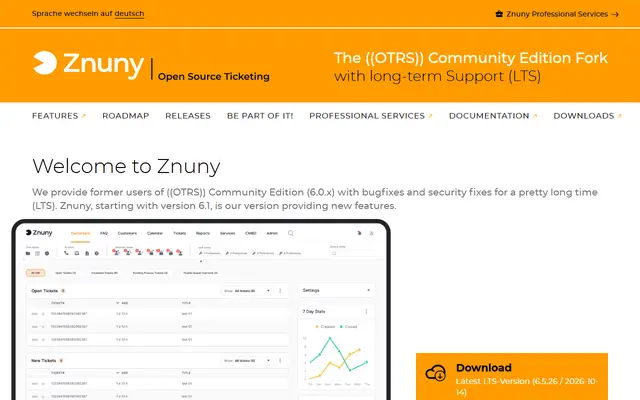
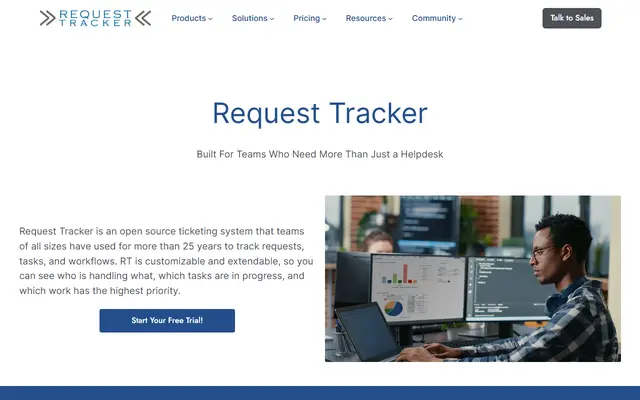
Eleven open-source entries cover very different ground. GLPI is described as inventory, tickets and CMDB. iTop (Combodo) is open-source ITSM plus CMDB, and i-doit is CMDB and IT documentation. Znuny is a fork of OTRS Community Edition and OTOBO a fork with ITSM modules. Zammad is ticketing but not full ITSM, osTicket is simple ticketing, Peppermint a light request tracker, and Frappe Helpdesk runs on ERPNext. FreeITSM is described as free with 18 modules, and Request Tracker as an old open-source tracker, not confirmed in our search review.
The decision usually comes down to scope. If you need a configuration database with relationships between assets and services, look at iTop, GLPI or i-doit. If you only need a clean ticket queue with email integration, Zammad, osTicket or Peppermint are lighter. The OTRS forks sit in between, with process depth and a long history.
Remember the hidden costs: hosting, backups, security patches and upgrades are yours. Check how recently each project released updates and how active its community is. The open-source hub explains the evaluation steps for this type.
| Site | Name | Type | Founded | Majestic rank | Check |
|---|---|---|---|---|---|
 | iTop (Combodo) | Open source | n/a | n/a | seen in search |
 | GLPI | Open source | 2003 | #9,788 | seen in search |
 | Znuny | Open source | n/a | #289,615 | seen in search |
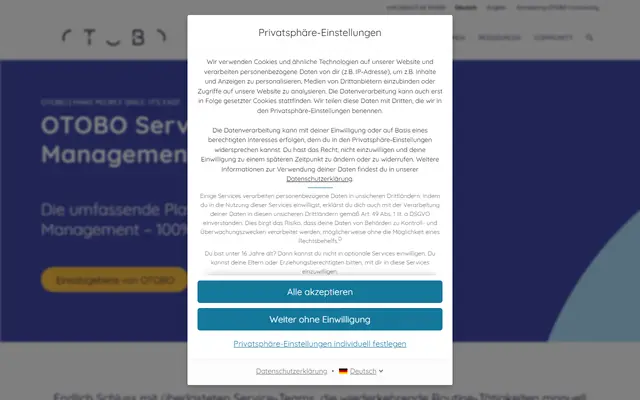 | OTOBO | Open source | n/a | #952,690 | seen in search |
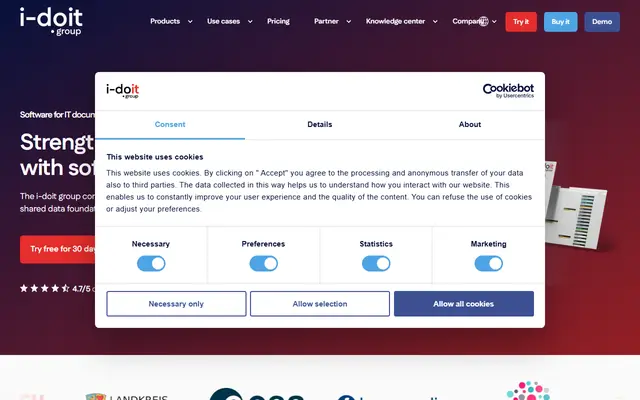 | i-doit | Open source | n/a | #361,676 | seen in search |
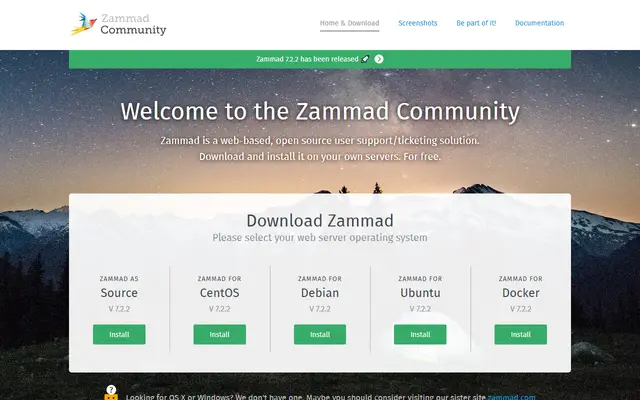 | Zammad | Open source | n/a | #133,819 | seen in search |
 | osTicket | Open source | n/a | #3,911 | seen in search |
| FreeITSM | Open source | n/a | n/a | seen in search | |
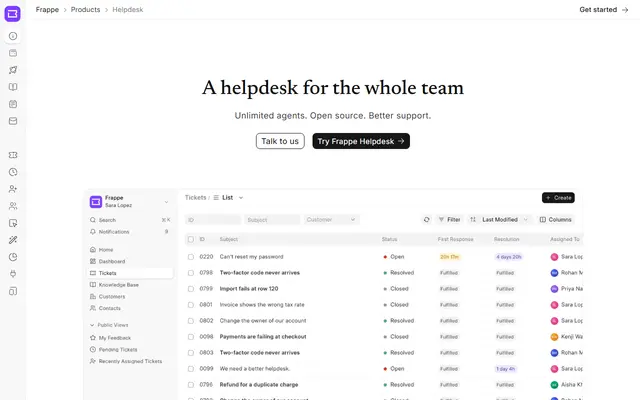 | Frappe Helpdesk | Open source | n/a | n/a | seen in search |
| Peppermint | Open source | n/a | n/a | seen in search | |
 | Request Tracker (RT) | Open source | n/a | n/a | unconfirmed |
Self-hosted alternatives to ServiceNow (1)
Software you run on your own server or computer. You keep control of the data and the uptime, and you take on updates, backups and security. For ServiceNow, this list contains 1 entry in this group, including Jira Service Management Data Center. See all self-hosted alternatives across every product →
Choosing among self-hosted alternatives to ServiceNow
The self-hosted group has a single entry: Jira Service Management Data Center, described as running on your own server under an Atlassian licence. It was not confirmed in our search review, so check Atlassian's current offering before planning around it.
Self-hosting is a deployment choice, not a product category, so many other entries can also run on your servers. ManageEngine ServiceDesk Plus has an on-premises option, Deskpro is described as a help desk with on-premises deployment, and every open-source product above can be installed locally. Treat the self-hosted type as a prompt to ask each vendor how installation, upgrades and support work.
Reasons to host yourself usually include data residency, network isolation or a policy against external cloud services. The cost is operational: capacity planning, backups and patching. Compare that against vendor cloud with a documented data-location commitment. The self-hosted hub lists more examples across categories.
| Site | Name | Type | Founded | Majestic rank | Check |
|---|---|---|---|---|---|
| Jira Service Management Data Center | Self-hosted | 2002 | #502 | unconfirmed |
Regional and local alternatives to ServiceNow (8)
Vendors that are strongest in a particular country or region: local languages, local payment methods, local data-residency rules and local support hours. For ServiceNow, this list contains 8 entries in this group, including Naumen Service Desk, SimpleOne, Okdesk, TOPdesk and Matrix42. See all regional alternatives across every product →
Choosing among regional alternatives to ServiceNow
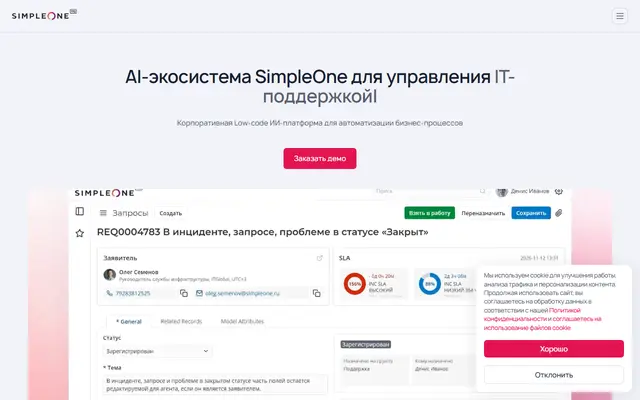
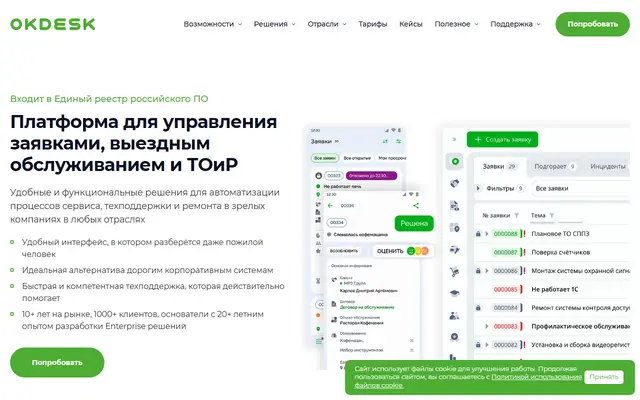
Eight regional entries come from Russia, Europe and Latin America. From Russia: Naumen Service Desk (founded 2001, noted as a Russian ITSM for import substitution), SimpleOne (a Russian ITSM platform) and Okdesk (for service companies). From Europe: TOPdesk (a modular ITSM headquartered in the Netherlands), plus Matrix42 (German ESM and ITSM), EasyVista (French ITSM) and Efecte (Finnish ESM), none of which were confirmed in our search review. From Latin America: Movidesk, a Brazilian help desk and ITSM.
Regional vendors matter when language, support hours, local regulation or procurement rules decide the purchase. A vendor that operates in your time zone and language can shorten onboarding. The trade-off is a smaller ecosystem of partners and integrations compared with global suites.
When evaluating, ask where data is stored, which local legal requirements the vendor addresses, and how large the local partner network is. Read about TOPdesk specifically on its alternatives page and about the type on the regional hub.
| Site | Name | Type | Founded | Majestic rank | Check |
|---|---|---|---|---|---|
 | Naumen Service Desk | Regional · Russia | 2001 | #197,985 | seen in search |
 | SimpleOne | Regional · Russia | n/a | #506,864 | seen in search |
 | Okdesk | Regional · Russia | n/a | #531,292 | seen in search |
 | TOPdesk | Regional · Europe | 1997 | #85,159 | seen in search |
 | Matrix42 | Regional · Europe | n/a | #106,046 | unconfirmed |
 | EasyVista | Regional · Europe | n/a | #180,459 | unconfirmed |
 | Efecte | Regional · Europe | n/a | n/a | unconfirmed |
 | Movidesk | Regional · Latin America | n/a | #136,944 | seen in search |
Built-in features of platforms you already use to ServiceNow (1)
Capabilities that already ship inside a suite or platform you pay for. They rarely match a specialist tool feature for feature, but they cost nothing extra. For ServiceNow, this list contains 1 entry in this group, including Power Apps + SharePoint Lists. See all built-in alternatives across every product →
Choosing among built-in alternatives to ServiceNow
One built-in route appears: Power Apps combined with SharePoint Lists, described as your own request system inside Microsoft 365. It was not confirmed in our search review as a packaged product, which is natural, because this is something you assemble rather than something you buy.
The appeal is that you reuse licences, identity and permissions you already have. A simple request form with an approval step can be built quickly for a single use case such as equipment orders or access requests. The limits show up when you want service-level timers, a knowledge base tied to tickets, asset relationships or reporting that auditors accept.
Decide in advance who will own and maintain the app. A home-grown system tends to depend on one or two builders, and their departure becomes a risk. Document the data model, keep exports of the lists, and set a threshold, such as ticket volume or number of processes, at which you would move to a proper product. The built-in hub discusses this trade-off across categories.
| Site | Name | Type | Founded | Majestic rank | Check |
|---|---|---|---|---|---|
| Power Apps + SharePoint Lists | Built-in | n/a | n/a | unconfirmed |
Adjacent tools to ServiceNow (5)
Products that cover part of the job or approach it from another angle. Useful when you only need a slice of the original product. For ServiceNow, this list contains 5 entries in this group, including Process.st, Gumloop, Zluri, Hiver and Lansweeper. See all adjacent alternatives across every product →
Choosing among adjacent alternatives to ServiceNow
Adjacent tools solve part of the problem rather than replace the platform. Five appear here: Process.st for processes and checklists only, Gumloop for AI-driven automation of scenarios, Zluri for SaaS and access management, Hiver for requests inside Gmail, and Lansweeper for IT asset inventory, not confirmed in our search review.
They fit when you are not really leaving ServiceNow's core function but trimming its footprint. A team that only needs onboarding checklists may find Process.st enough, while an IT group that struggles with inventory could start with Lansweeper. Hiver suits small teams already working from a shared Gmail inbox.
The risk is stitching together several tools and recreating the fragmentation you wanted to avoid. Map each adjacent tool to a specific gap, define how data flows between it and your main ticket system, and stop adding tools when the integration overhead exceeds the gain. See the adjacent hub for the type definition.


DIY and self-made approaches to ServiceNow (2)
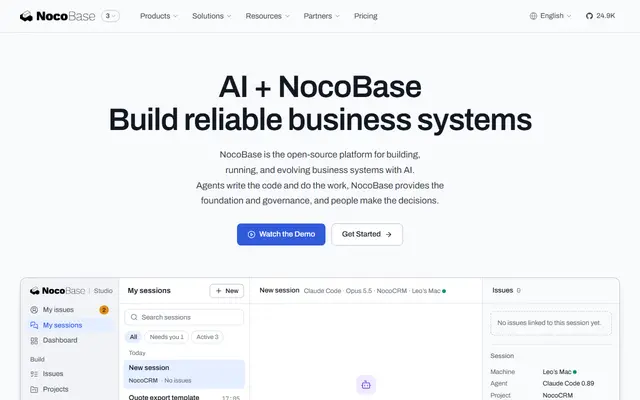
Spreadsheets, scripts and workflows you assemble yourself. Cheap and flexible for small needs, but they depend on whoever built them. For ServiceNow, this list contains 2 entries in this group, including NocoBase and Notion/Airtable request database. See all diy alternatives across every product →
Choosing among DIY alternatives to ServiceNow
The DIY group has two entries: NocoBase, described as low-code with which you build your own ITSM, and a Notion or Airtable request database, described as a manual request base. The second was not confirmed in our search review as a specific product.
DIY works when the process is small, unusual or changing quickly, and when you have someone who enjoys building it. A low-code platform lets you define your own tables, forms and approval flows. A database in Notion or Airtable is faster still but leans on manual discipline.
The risk is that you inherit the full product-management job: permissions, audit trails, notifications, backups and documentation. Before you build, list the features you would have to rebuild and compare that effort against a small commercial or open-source service desk. See the DIY hub for how this type is defined elsewhere.
Migration checklist: moving away from ServiceNow
Moving a service management platform is as much an organisational project as a technical one. Plan it in phases, keep the old system readable until the new one has handled a full cycle of real work, and agree on what counts as done before you start. The points below are general practice for ITSM migrations and not statements about any vendor's tooling.
Start with an inventory of what you actually use. Export a list of active workflows, catalogue items, notification rules, integrations and custom fields, and mark each as keep, simplify or drop. Many teams discover that a large share of configuration is unused. Then decide how much history to carry across: open tickets, closed tickets for a defined period, knowledge articles and asset records each have different value.
Run the new system in parallel for a short pilot with one team or one service, and review the results against your own measures such as response time and reopen rate. Plan communication for requesters and agents, including a short guide and a place to report problems. Only retire the old platform after the data export has been checked and archived according to your retention policy.
- List every integration with monitoring, identity, chat, email and endpoint tools and decide how each reconnects.
- Export tickets, knowledge articles, asset and CMDB records, and test the import into the target on a sample.
- Map ticket states, priorities and categories between old and new systems before importing.
- Rebuild approval chains and notification rules deliberately instead of copying every old rule.
- Pilot with one team, collect feedback, then widen the rollout in stages.
- Train agents and publish a short guide for requesters with the new portal address.
- Keep a read-only archive of the old data until your retention requirements are met.
- Review contract end dates and notice periods so you do not pay twice longer than necessary.
Mistakes to avoid when switching
The most common mistake is picking a replacement from a feature checklist alone. A tool can tick every box and still be wrong for your team if it takes a specialist to configure or if its process vocabulary does not match your auditors' expectations. Test it on your own queue instead.
A second mistake is moving everything. Migrating years of closed tickets and abandoned workflows imports clutter along with data. Be selective, and archive the rest in a format you can search. A third is underestimating the people side: agents who have built habits around one interface need time and a clear reason for the change.
Finally, do not treat a labelled cheaper product as a cheaper project. Implementation effort, integration work and training are costs even when the licence is low, and our public data cannot quantify them for you.
- Choosing by brand or review count without testing your own scenarios.
- Copying every legacy workflow instead of redesigning the useful ones.
- Ignoring the exit route in the new tool, such as how you export data later.
- Cutting over everyone on a single day with no pilot group.
- Relying on an entry that was not confirmed in our search review without checking with the vendor.
- Forgetting to renegotiate or cancel the old contract in time.
What the public data says about these alternatives
Our data lists 50 alternatives. By type, direct is the largest group with 15 entries, followed by open-source with 11 and regional with 8. Adjacent has 5 entries, budget and enterprise have 3 each, DIY has 2, and free, self-hosted and built-in have 1 each. The weight toward direct and open-source options suggests that most people looking away from this platform either want another commercial suite or want to drop the licence fee.
ServiceNow itself was founded in 2004 and has a Majestic rank of 3,668. Among alternatives with a rank, Jira Service Management (via atlassian.com) stands out at 502, Zendesk at 204 and Salesforce at 344, while Freshservice is at 3,029, Spiceworks at 3,603, osTicket at 3,911 and SolarWinds at 4,713. Many open-source and regional entries rank in the hundreds of thousands, which says more about audience size than about quality.
Founding years in the data range from 1980 for BMC Helix and 1985 for Ivanti to 2010 for Xurrent. Countries represented in the regional group are Russia, the Netherlands, Germany, France, Finland and Latin America. Ten of the 50 entries are marked as unconfirmed in our search review, so verify them before relying on them.
Frequently asked questions
What is the best free alternative to ServiceNow?
There is no single best option, and our data does not rank them. Spiceworks is the one entry listed as free, noted as free with advertising. If you accept hosting it yourself, open-source products such as GLPI, Zammad, osTicket and Frappe Helpdesk carry no licence fee, but you pay in administration time.
Are there open-source alternatives to ServiceNow?
Yes. Our list includes eleven open-source entries: iTop (Combodo), GLPI, Znuny, OTOBO, i-doit, Zammad, osTicket, FreeITSM, Frappe Helpdesk, Peppermint and Request Tracker. They range from full ITSM and CMDB tools to simple ticket trackers, so match the scope to your needs and check update activity.
What is the cheapest ServiceNow alternative?
We do not publish prices, so we cannot name the cheapest. Our budget-friendly group has ManageEngine ServiceDesk Plus, Zoho Desk and ProProfs Help Desk, each described as inexpensive or simple. Ask vendors for current quotes, including add-on modules, and compare total cost including implementation and training, not only licence fees.
Which alternatives are closest to ServiceNow for large companies?
Based on our data, BMC Helix is described as a direct enterprise competitor, and Ivanti Neurons for ITSM as enterprise ITSM plus endpoints. Salesforce Service Cloud is enterprise-grade but oriented to customers. Run a proof of concept on a real process before deciding, because fit depends on your workflows.
Can I export my data when switching from ServiceNow?
Export options depend on your contract and configuration, which we do not cover. As a general approach, request tickets, knowledge articles, asset and CMDB records in a structured format, test importing a sample into the new tool, and keep a read-only archive until your retention obligations are satisfied.
Are there European or regional alternatives?
Yes. TOPdesk is a modular ITSM headquartered in the Netherlands. Matrix42 (Germany), EasyVista (France) and Efecte (Finland) were not confirmed in our search review. Russian options include Naumen Service Desk, SimpleOne and Okdesk, and Movidesk is a Brazilian help desk and ITSM. Check support hours and data location for each.
Is Jira Service Management a good fit for IT teams?
Our data notes Jira Service Management for its link to development work through Atlassian, and it is among the direct alternatives. Whether it fits you depends on your processes and team habits. Test it with a sample of your own incidents and change requests before deciding.
Can I build my own ITSM instead of buying one?
It is possible. NocoBase is described as low-code for building your own ITSM, and Power Apps with SharePoint Lists as a request system inside Microsoft 365. Be realistic about maintenance: you take on permissions, audit trails and backups yourself, so set a point at which you would move to a product.
How were these alternatives selected?
They were compiled in November 2026 from public sources such as vendor sites, search results and comparison pages. Entries are classified by type, and some are marked as not confirmed in our search review. We did not test the products. Read the methodology page for the full approach and limits.
Bottom line
No alternative replaces a large ServiceNow deployment without trade-offs. The right question is which parts of the platform you really use. For a team that needs incidents, requests and a knowledge base, simpler commercial tools such as Freshservice, SysAid or ManageEngine ServiceDesk Plus may be enough. For a team that needs deep process and CMDB control, BMC Helix and Ivanti Neurons for ITSM are the closest comparisons in our data.
If licence cost or data control drives the decision, the open-source and self-hosted groups deserve a serious look, provided you budget for hosting and upkeep. Regional vendors such as TOPdesk, Naumen or Movidesk make sense when language and local support matter. Build a shortlist of three to five, request trials, and read the methodology so you know what our data does and does not cover.
More alternatives pages related to ServiceNow
- monday.com alternativesDocs & productivity
- Zendesk alternativesCustomer support
 Zoho CRM alternativesCRM & Sales
- Ivanti alternativesIT & monitoring
- Salesforce alternativesCRM & Sales
- TOPdesk alternativesIT & monitoring
 Microsoft App Center alternativesIT & monitoring
 Scalefusion alternativesIT & monitoring
Where ServiceNow shows up as an alternative
ServiceNow appears in the alternatives lists of 2 other products: Ivanti, TOPdesk. Comparing those lists shows which tools keep being recommended across the whole category.
Explore more in IT Management & Monitoring
Service management, infrastructure monitoring, device management and remote access. Browse the full IT Management & Monitoring hub, or jump to a related comparison: Microsoft App Center, Scalefusion, Ivanti, LogMeIn, PRTG, Datadog, TOPdesk.